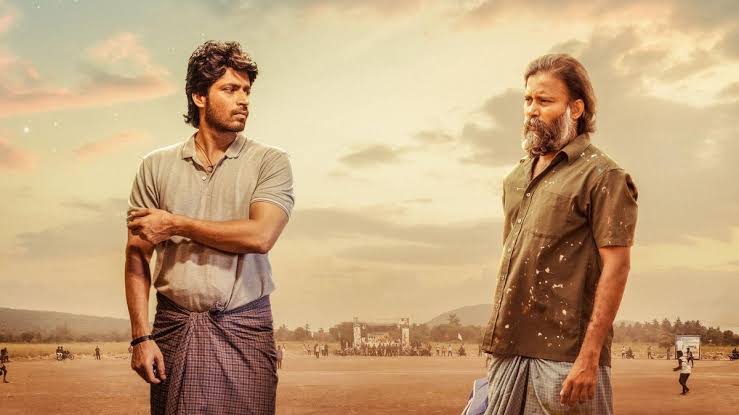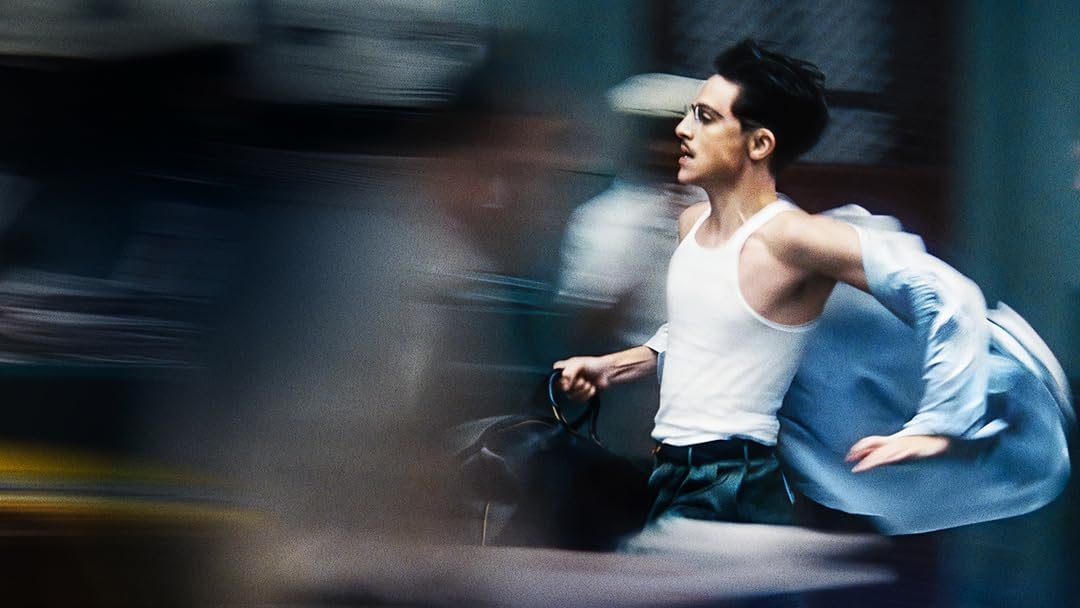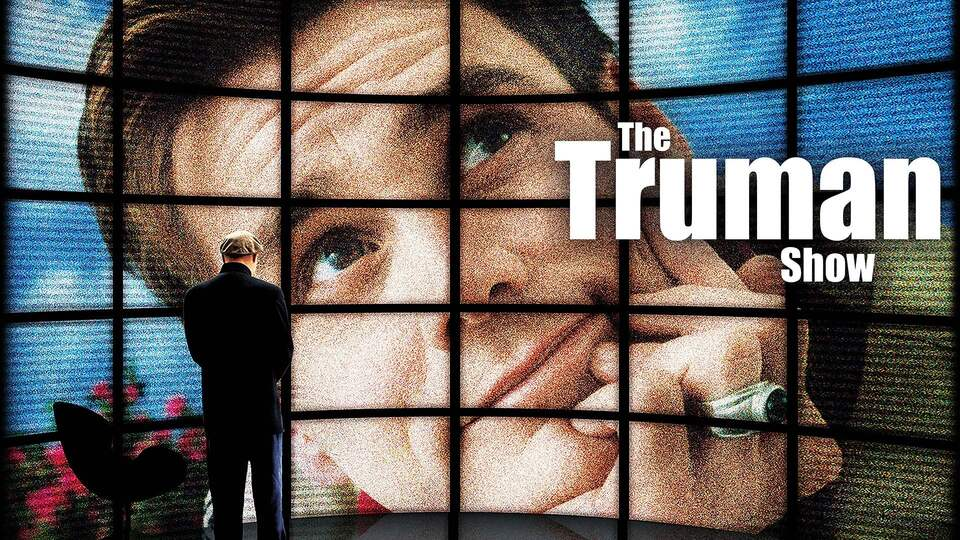
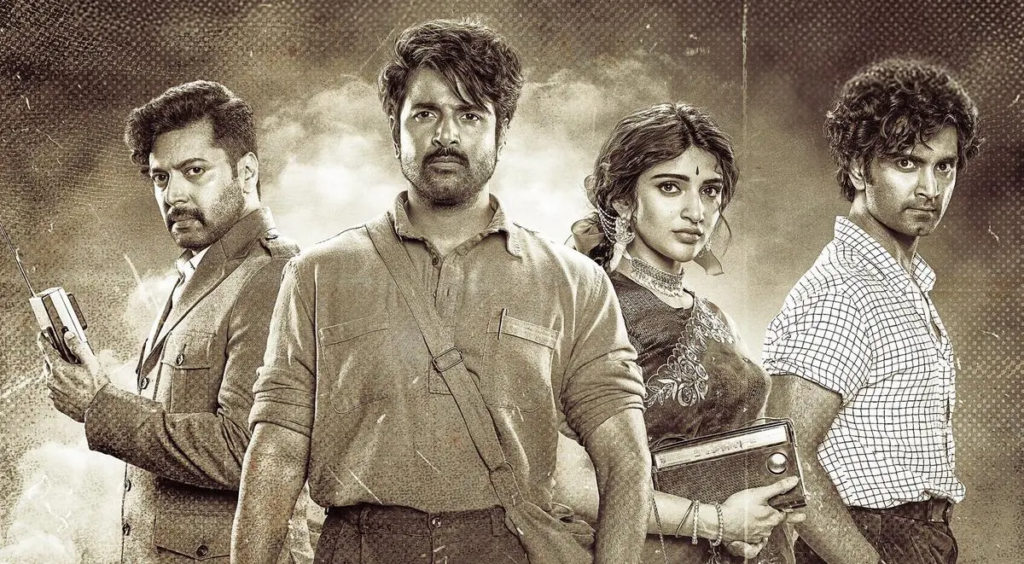
Alright, I’ll level with you. This movie was not the first choice that I wanted to watch this past weekend. I’m one of the many of you who had hope to catch the last dance of a certain aspiring politician. But that changed when I actually got to know what Parasakthi was about. Maybe it’s the Chennaite in me, or maybe it’s just plain me. So, what do we talk about this?
Nee oru Anti-Hindian Machan!
So what if I am? I’m just kidding, fellas. This film’s cornerstone is about a student movement that rallied against the government’s policy to affix Hindi as the common, official, or, for lack of a better word, national language.
You know what, it was not until I was in college that I realized my school failed me. Between the classes of 4-8 every first essay in the lambi-wali Hindi Composition notebooks was, and I kid you not,— Hindi Hamara Rashtrabasha Hai!
That’s what Sudha does. Historical fiction is right up her forte. Telling those tales, but exaggerated in a commercial entertainment format. It worked pretty well for me in Soorarai Potru. While she does not present a factual retelling, this is like an entry point that will actually get people talking and wanting to get the facts themself. And she did succeed in her previous film. But did it work this time?
Yes and No.
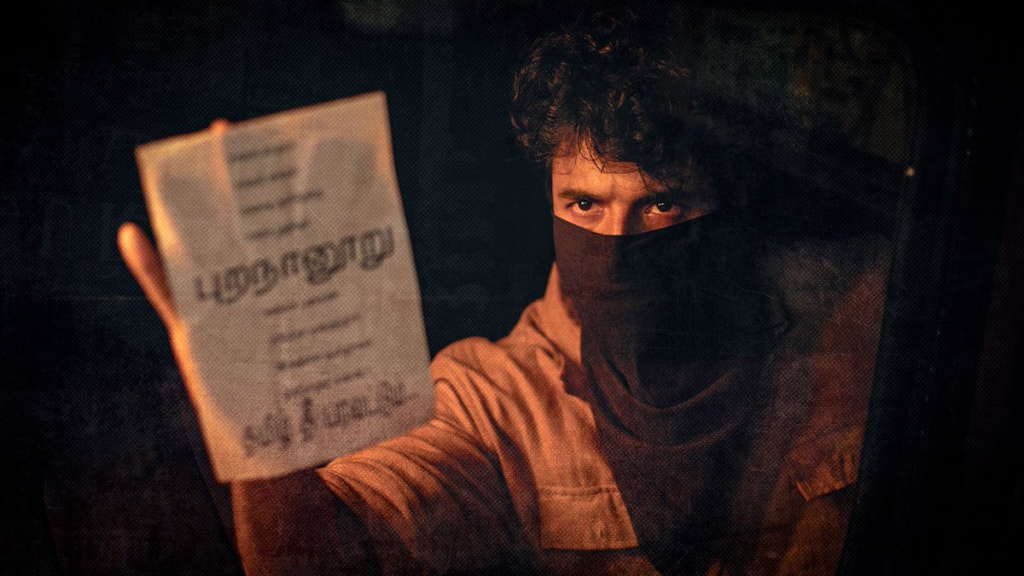
Let me start with no first (so that the positives stick with you while you finish reading this post!). What let me down with this film, I can’t place it exactly, but something felt lacking with respect to how the story was told. I religiously believe that screenplay and storytelling are two of the most important tools when it comes to film. (Thank you, lord Joss Whedon, for helping me understand this!)
I’ll break it down for you. If I wanted to play things out the way I imagine them, I would prefer to read long text. If I wanted to understand what you felt without your vocabulary, I would want to listen to a soundtrack. If I want to see things as you see, feel them as you do, emote as you felt, I turn to film. It’s me seeing things through your lens. And that did not translate across the screen. Through no fault of the performers.
I saw a lot of reviews that said the writing let this down. While I agree, I do not think it was just the writing. There was something that just felt non-cohesive throughout the film. It’s not a matter of high expectations. But you’ve got a dynamite of a story here. Yet the entire story, while I empathized with it, I did not feel it. The film felt informative throughout crucial elements, rather than pulling me into the narrative and making it an immersive experience.
I also wasn’t a fan of the one-dimensional, rocky, mono-expressional antagonist in Ravi Mohan (You’ve done better, bro!). The forced romance track between SK-Sreeleela (I mean, Atharva-Sreeleela sibling track carried enough emotional weight already). And the supposed 25 censor cuts and incessant muting of dialogues did not help!
The Prodigal Son Returns
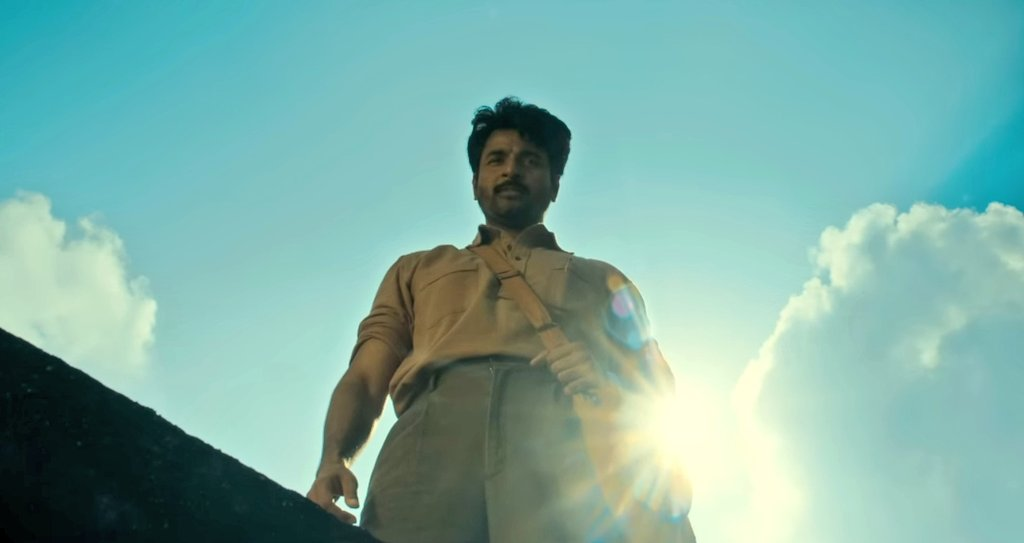
Onto the good stuff. This shot right here was my favourite in the film. Of course, there’s a better one of it in the film than this screengrab I got off of Google. But the elevation sequence at this point, with this particular camera angle, and the silhouette shot of an emergent leader from the shadows — the second closest to goosebumps I got in this film.
Powerful dialogues. And dialogue that made sense. From both an artistic and a practical point of view. Particularly, some of which try to explain that forcing a person to let his language go does not simply mean letting go of the language. Hell, it does not even mean letting go of one’s identity (this should already rile you up.). But it derails you from thinking. I mean, ask yourself — What language do you think in? And when you don’t think, you don’t grow. And that means killing the potential of one person could be. To me, that sounds like one of the saddest things that could happen to a person.
By no means was this a bad film. I just feel like it left a lot more in the tank than it did on the screen. I’m hoping an uncensored version surfaces in the coming months. Will definitely revisit this film. The message was clear. I understood the assignment. And Sudha once again succeeded in making me dig deep into the actual lore of something I was unaware of. All this time, I thought it was just me. But hey, I guess.. rathathulaye ooriruku xD!
SHITT!! I PUBLISHED THIS WITHOUT ADDING A COMMENT OF THE BESTEST CAMEO IN THE FILM!
WATCH IT!!!!!
We’ve all been there
While this film focused on a singular language to honour the movement, the message it tries to deliver is not restricted to any single language or community. Yet another dialogue in the film states that the protagonists weren’t against a community or a language, but rather the imposition of such for an unreasonable justification. As someone who’s faced such micro-aggressions in the past and had the toughest of times because of it, I’ll just put this here – try to put yourselves in the other person’s shoes for a minute. Then try to think how it’ll feel if it’s for eternity.
Oh, I almost forgot! This film had GV Prakash’s music. (Yeah, it was exactly this memorable that I wanted to a force an afterthough joke out of it!) C’mon GV naa!! Go back to your Oru Paadhi Kadhavu days and cook!